AI visibility assessment

Will AI systems recommend your business? Find out in three days.

More and more people are asking ChatGPT, Gemini or Perplexity for a solution rather than using a traditional search engine. We ask these systems the questions your customers are actually asking and analyse every response.

€590one-off
3 daysfrom approval of the question catalogue
Expert reviewedTechnology meets expert judgement

We work with businesses, non-profits and institutions across the German-speaking market.

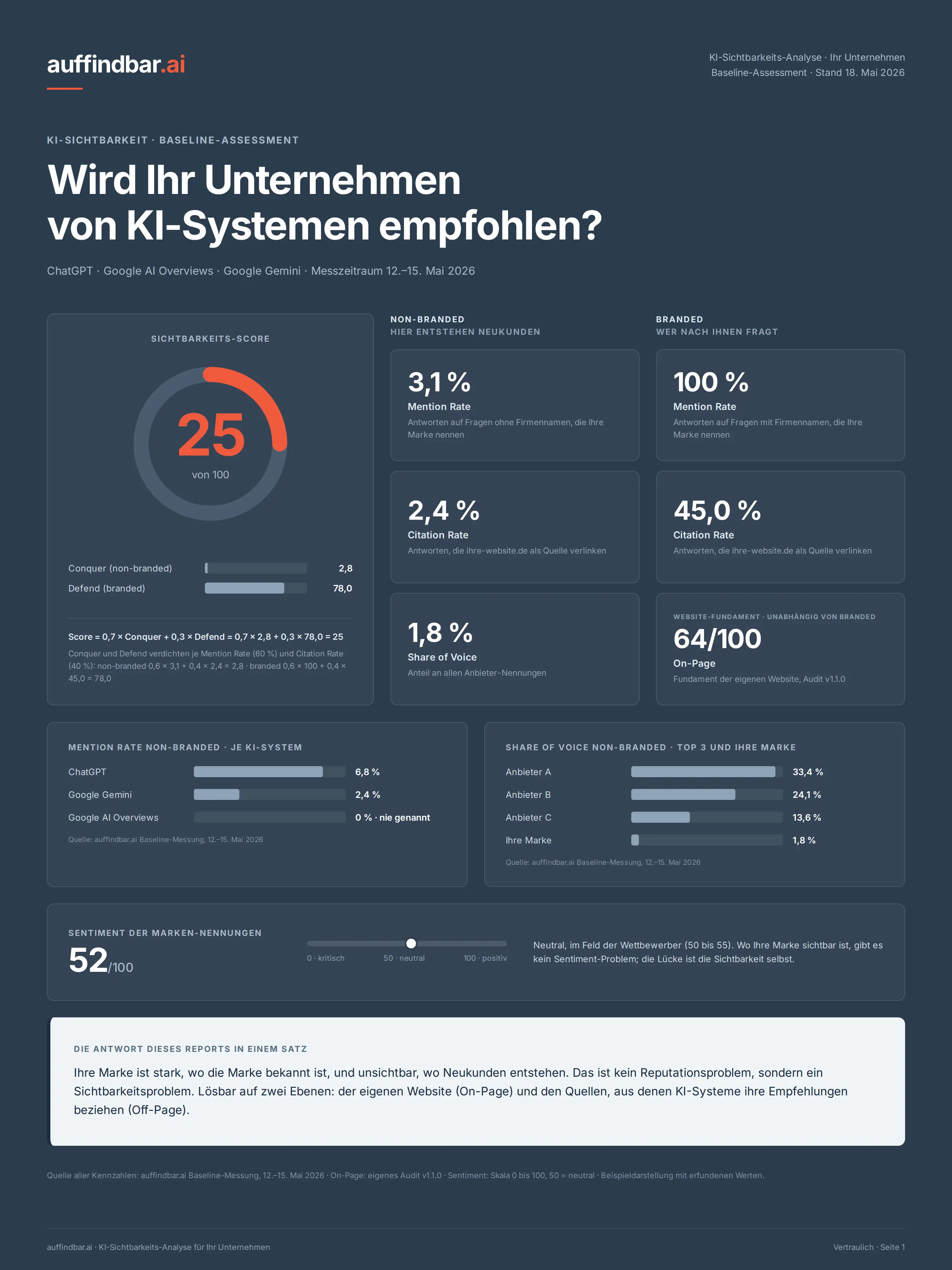
Cover of the AI visibility report showing the Visibility Score and all key metrics.

What you receive

You receive two documents. You have the final say on the first.

Both are created specifically for your business, not generated from a template. We go through them with you and explain every figure. After that, they are yours.

Document 1

The Question Catalogue

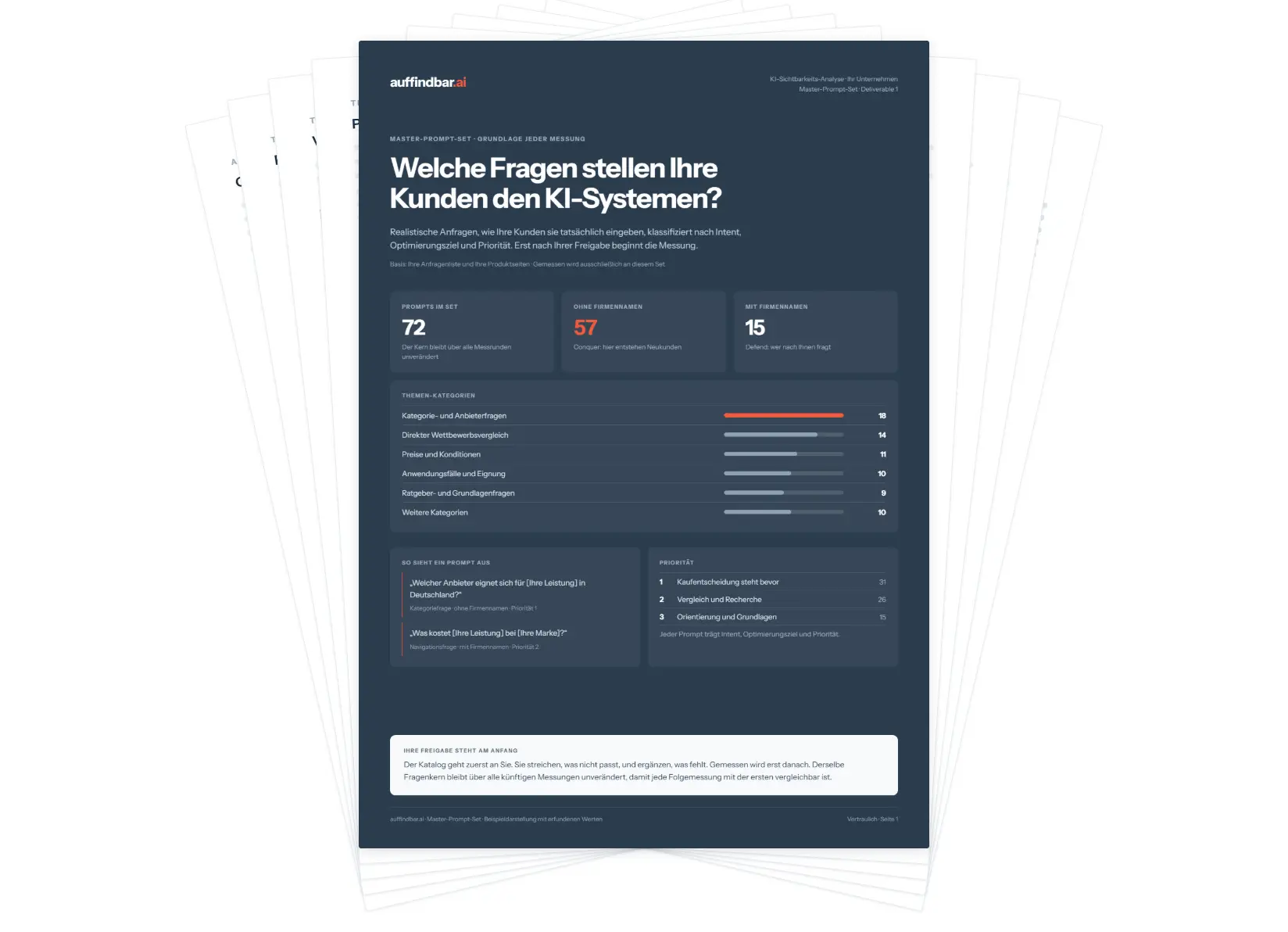
People search differently in AI systems than they do in search engines. They ask complete questions, describe their situation and formulate requests. The catalogue contains the prompts we use to measure your visibility.
The question catalogue, fanned out

The question catalogue, fanned out

01Realistic queries that potential customers might actually enter into AI systems, both with and without your company name.

02Organised around the topics you offer, so you can later see where you appear and where you do not.

03Classified by intent, optimisation objective and priority. Not every prompt carries the same weight.

04A rationale for every prompt. You can see why each question is included and what it is intended to measure.

The catalogue comes to you first. You remove anything that does not fit and add anything that is missing. Only then do we measure.

Document 2

The AI visibility report

The AI visibility report is 15–20 pages and consists of six sections.

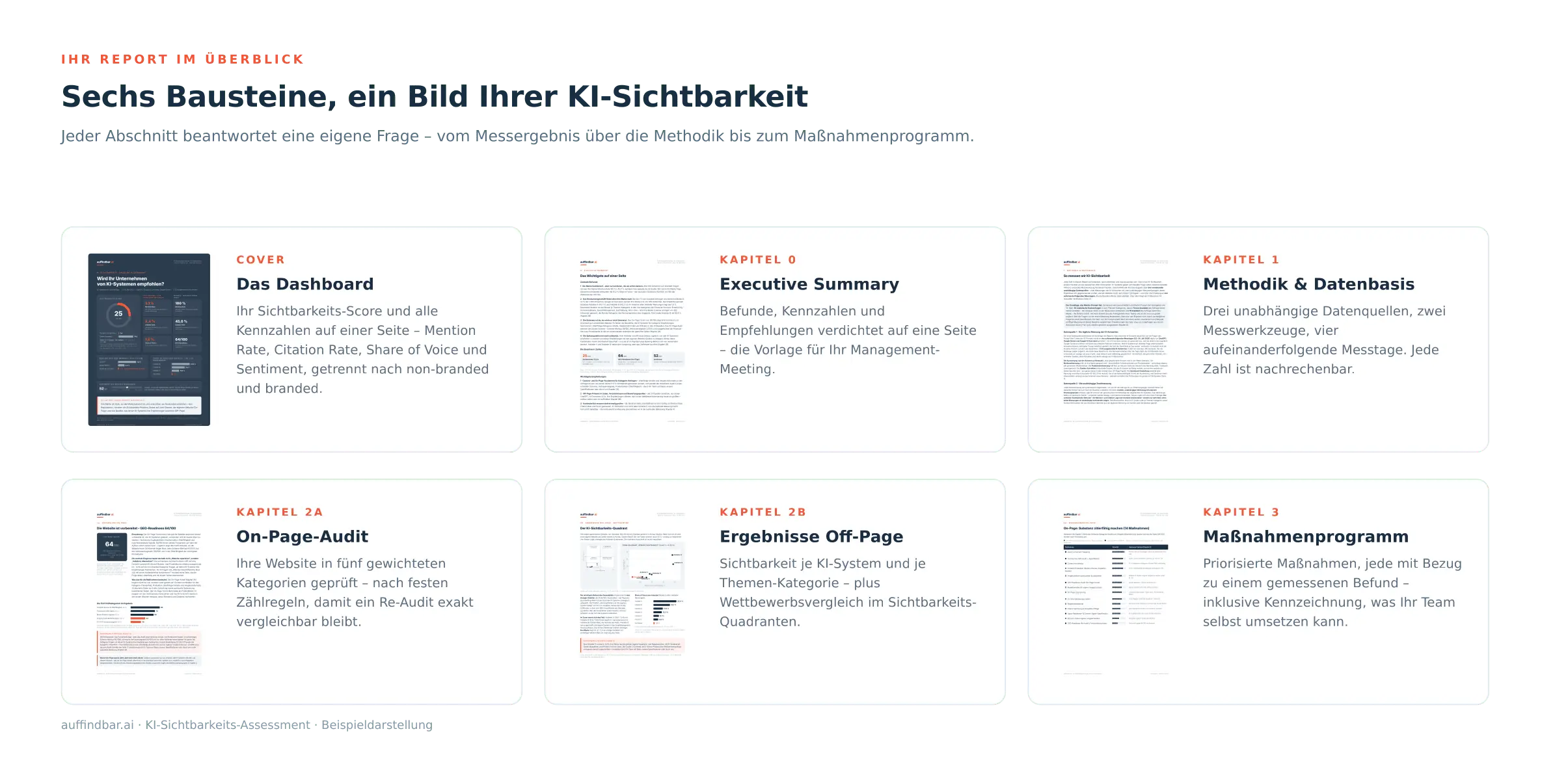
The six chapters of the AI visibility report at a glance.

The six chapters of the AI visibility report at a glance.

01Dashboard: your Visibility Score and five additional metrics on one page, separated between prompts with and without your company name.

02Executive Summary: findings, metrics and recommendations condensed onto one page. This is your starting point for a management meeting.

03Methodology and Data: we show exactly what we measured and how we counted it. Every figure in the report can be reproduced.

04On-Page Audit: we examine how well your website is structured to be read, understood and cited as a source by AI systems. We count rather than judge. For example, a page must have exactly one main heading. Zero or multiple main headings result in a defined point deduction. Fixed counting rules make subsequent measurements directly comparable with the first.

05Off-Page Results: your overall visibility, broken down by AI system and topic category, plus a competitive comparison: which providers are recommended in your market and whose pages are cited as sources.

06Action Plan: all recommended actions ranked by importance, each directly linked to a measured finding. For every action, we indicate whether it can be implemented in-house according to our methodology.

One of our founders personally takes you through the report.

Our measurement rule

Why you see the catalogue first

A measurement is only as good as its questions. That is why the question catalogue is fixed before we measure. You know exactly what will be measured in advance, and the result cannot be influenced by selecting questions after the fact. The core of the catalogue remains the same for every repeat measurement. That is the only way to compare a second measurement with the first.

Request an AI visibility assessment →

How it works

Four steps from request to results

01

We develop the question catalogue

Based on your topics and our research, we formulate the prompts: questions your customers might ask when they are trying to solve a specific problem.
02

You approve the catalogue

You receive the catalogue before measurement, review every question and adjust it where necessary. Measurement only begins once you approve it.
03

We measure and review

We submit every prompt to the AI systems relevant to your market multiple times. At the same time, we examine your website from the outside, without requiring access to your systems.
04

We analyse the results and discuss the report

We calculate the metrics, compare them with your competitors and derive the recommended actions. We then discuss the report with you rather than simply sending it over.

Three days from your approval to the completed report.

What you need to do

Your involvement is limited to two things: reviewing the question catalogue and taking part in the report discussion. You do not need to provide system access, data exports or prepare your team. Everything else is our responsibility.

What happens after the initial measurement

The initial measurement is your baseline. Afterwards, we recommend a monthly follow-up measurement under identical conditions. That is the only way to distinguish a genuine change in your visibility from a change in the system’s response. The follow-up measurement is included in the retainer.

Who does the measuring?

Who discusses the report with you

auffindbar.ai is a Generative Engine Optimization agency based in Leipzig, Germany. We focus exclusively on GEO, working with businesses, non-profits and institutions across the German-speaking market. Your assessment is not produced by an anonymous tool. We develop the question catalogue with you, and one of our founders personally discusses the report with you. You can learn more about how we work on our About us page.

Only you see the report. We do not use your results as a reference or case study without asking you first, and we process measurement data exclusively for your engagement. That is also why you will not find customer logos on this page.

Dennis Doerfl, Co-founder and CEO Thomas Müller, Co-founder and CMO

Dennis Doerfl, Co-founder and CEO

Thomas Müller, Co-founder and CMO

Book a free intro call → booking page in German

Pricing

€590 one-off. If you continue, the fee is credited in full.

If you decide within 60 days to continue with ongoing support, we credit the full amount against your retainer. Your assessment is therefore effectively free if you continue with us.

The starting point

AI visibility assessment

€590 one-off · Report delivered three days after your approval

  • Question catalogue for approval
  • Measurement across the AI systems relevant to your market
  • Website assessment using fixed counting rules
  • 15–20-page report with six metrics and competitive comparison
  • Action plan ranked by importance
  • Joint review of the report

If you subsequently book a retainer, we credit the full amount within 60 days. In effect, you pay nothing for the assessment.

No obligation to continue

The assessment stands on its own

Both documents are yours. Every action in the plan states whether it can be implemented in-house according to our methodology. You do not have to book anything afterwards.

Request

Let’s start with the findings.

Four pieces of information are enough. We will contact you by email with details of the next steps. You decide whether this becomes an engagement.

* Required field

We reply by email. Your enquiry is non-binding and does not constitute an order. A binding agreement is only formed once we confirm your enquiry by email or in a conversation. We use your details only to respond to your enquiry. How we process them is set out in our privacy policy .

Prefer to talk first?

Not sure whether the assessment is right for you? In 20 minutes, we can determine whether GEO is the right lever for you right now, or whether other priorities should come first.

Book a free intro call → booking page in German

For those who want to check the maths

The six metrics and how we calculate them

This section is for anyone who wants to understand how the numbers are calculated before booking. You do not need to read it to make a decision.

The six metrics at a glance

These six metrics are how we measure your AI visibility, consistently separated between prompts with and without your company name. The report breaks them down further by AI system, topic category and competitor, but introduces no additional metrics. The definitions remain identical across every measurement. Every figure should be robust, traceable and reproducible. We disclose the complete formula for the Visibility Score, and you can reproduce every calculation. A score without a calculation path is not a metric. It is a claim.

Mention Rate
The percentage of AI responses in which your brand is mentioned. The unit we count is the individual response, not the prompt. Because every prompt is submitted multiple times and across multiple systems, one question produces many responses. We also report Mention Rate by AI system and topic category. Example: 3.1% for prompts without your company name, 100% for prompts with your company name. For prompts without your company name, this is where the question of whether AI responses lead new customers to you, or to a competitor, is decided.
Citation Rate
The percentage of AI responses in which a page from your website is visibly linked as a source. A background retrieval does not count. Only a visible source citation counts. We also report Citation Rate by AI system and topic category. Example: 2.4% without and 45.0% with your company name.
Visibility Score
Both views combined into a single score from 0 to 100. For each view: 0.6 × Mention Rate + 0.4 × Citation Rate. The overall score is: 0.7 × Conquer + 0.3 × Defend. Where Conquer = prompts without your company name, Defend = prompts with your company name. Mentions carry more weight because they represent the commercially decisive event. Citations are the lever you can influence directly. Conquer carries more weight because new customers emerge from queries where they are not already looking for a specific provider. These weights are fixed and remain unchanged for every follow-up measurement. Example: 25 out of 100.
Share of Voice
Your share of all provider mentions. This is a competitive-context metric and is deliberately not part of the Visibility Score. Example: 1.8%.
Sentiment
The tone of every mention, ranging from critical to positive on a scale of 0–100, with 50 representing neutral. This is the part of the analysis that requires the most interpretation, which is why we specifically control it through sampling. Example: 52, neutral.
On-Page
How well your website is structurally prepared to be read and cited as a source by AI systems. We assess five weighted categories using predefined counting rules. We count rather than judge. The same website in the same condition produces the same result, making progress objectively measurable. On-Page is deliberately excluded from the Visibility Score because it measures the cause, not the effect. It also tends to respond earlier than the other metrics. Example: 64 out of 100.

Example values only. Not actual customer data.

Why we submit every prompt multiple times

AI systems rarely produce exactly the same answer to the same prompt twice. That means the individual response is not the reliable unit of measurement. The reliable unit is the set of responses analysed. We store every response in full: the response text, all providers mentioned and all linked sources. The report documents the measurement volume and measurement period for your engagement in detail.

Why a Mention and a Citation are two different things

A Citation appears only when the system searches the live web to produce its answer. This process is known as grounding. Whether grounding occurs is decided by the system for each question. A Mention can also occur without a web search if the model already knows your name from its training data. That is why we measure the two separately.

Our measurement rule

What the measurement does not show

AI responses are personalised, location-dependent and constantly changing. They can also depend on whether someone is logged in and which version of a system they are using. Our numbers are therefore a sample measured under defined conditions. They are not a complete picture of every answer your customers may see. That is why we document the conditions and report every follow-up measurement separately. We measure visibility: whether and how AI systems mention and substantiate your business. Whether that visibility ultimately produces an enquiry or a sale is outside the scope of this measurement. Being explicit about these limitations is part of the methodology.

Frequently asked questions

What customers ask before booking

Do you need access to our website or analytics?

No. We measure from the outside: AI responses through our own queries and your website through the pages anyone can access. You do not need to provide system access or assign anyone from your IT team.

Do you use a standard question catalogue?

No. We create a new catalogue for every engagement. A catalogue designed to fit everyone measures nothing that necessarily matters to you. You see it before measurement and can change it.

Which AI systems do you measure?

We select the systems based on your market. In the German-speaking market, this generally includes ChatGPT, Google Gemini and Google’s AI search responses and, where relevant, Microsoft Copilot, Claude and Perplexity. We decide together which systems are included in your assessment and document them in the report.

Isn’t this just SEO?

No, but the two are connected. With SEO, your position in a list of links matters. With GEO, the question is whether you appear in a generated answer and whether your website is cited as a source. A strong Google ranking can help, but it does not guarantee visibility in AI answers. The discipline is also referred to as Answer Engine Optimization (AEO), Large Language Model Optimization (LLMO) or AI SEO. The underlying objective is the same.

What if the result is poor?

For an initial measurement, a low score is normal rather than exceptional. Very few companies have been deliberately structured for these systems. The score is your starting point, and every action in the plan is tied to a finding we actually measured.

Can we implement the recommendations ourselves?

Yes, and many companies do. Every action in the plan states whether it can be implemented in-house according to our methodology. Teams often make website changes themselves or produce content based on our briefs. How much you handle internally depends on your resources and capacity, not on us.

Is this worthwhile for a company our size?

Size is not the deciding factor. What matters is whether your customers research purchasing decisions through AI systems. A useful indicator is your existing behaviour: if you have invested in SEO, the same underlying argument now applies to GEO. The depth of the work then depends on your budget and capacity.

Which languages do you measure?

Our focus is German-language AI responses for the markets of Germany, Austria and Switzerland. If your business requires it, we can examine additional languages. We determine what is included when we develop the question catalogue with you.

How does billing work?

The contracting party is auffindbar.ai GbR, based in Leipzig, Germany. We issue the invoice after the engagement is commissioned, with a payment term of 14 days. The assessment costs €590 one-off. There are no additional costs, and the engagement does not renew automatically.

Why does the assessment cost €590?

Because the work is not primarily in collecting the data. It is in interpreting what should be measured. An automated system can collect information about your market and your business from public sources. What it cannot know is which product line matters next quarter, whether you are defending an existing position or entering a new category, which competitor is commercially dangerous rather than simply frequently mentioned, what budget and internal capacity you have, or what visibility is supposed to achieve: demand generation, recruiting, investor perception or something else. Those answers do not exist in a database. They come from the conversation. That is why we create the question catalogue before measurement and have you approve it.

Who gets to see the report?

You. We do not use your results as a reference or case study without asking you first. If we process personal data on your behalf, we enter into a Data Processing Agreement under Article 28 GDPR.