Analysis
How AI Recommendations Actually Work
What a study of the recommendation logic of ChatGPT, Gemini, Perplexity, and Claude shows
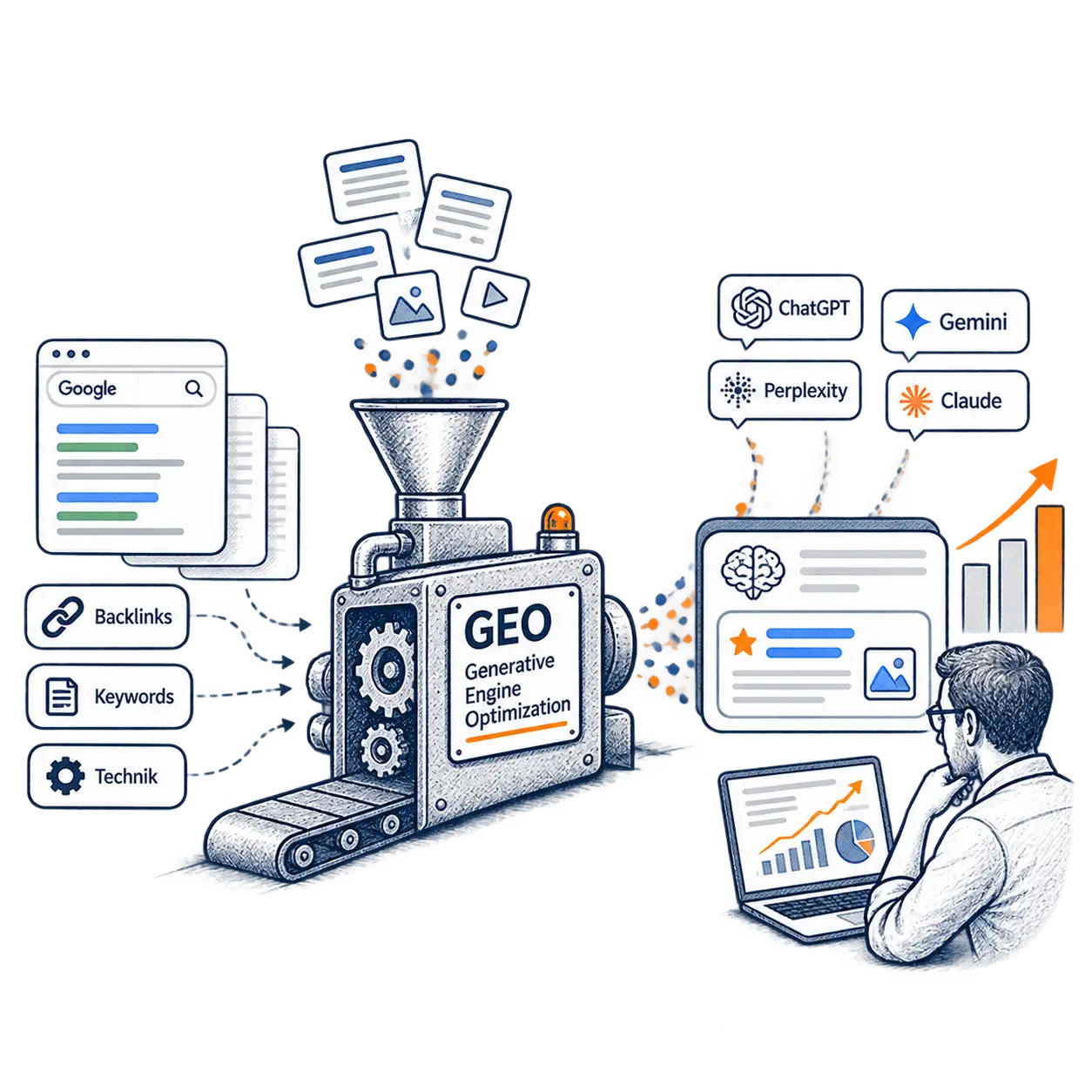
When a customer asks ChatGPT, “Where can I buy sustainable outdoor clothing online?”, the AI doesn’t simply return a random list. Behind the answer is a measurable system that weighs certain factors more heavily than others. This article explains how the four most relevant AI chatbots actually make recommendations—and what that means for German companies that want to become visible in these systems.
The foundation of this article is the most comprehensive empirical study of this topic to date: research by First Page Sage, a US-based GEO agency, which ran 11,128 commercial queries across the four largest AI chatbots between December 2023 and April 2026. Wherever specific figures or weightings are cited, we link back to the original research.
The AI Chatbot Market
Before diving into the individual algorithms, it is worth looking at market share.
Market Share of the Four Most Important AI Chatbots
US market, 2026
Data source: First Page Sage, 2026 market share study. Visualization: auffindbar.ai. No reliable comparable figures are currently available for the German market; based on our observations, ChatGPT is similarly dominant here.
The Eight Factors That Shape AI Recommendations
Across all four platforms, the First Page Sage study identifies eight factors that influence recommendation decisions. The weighting differs significantly between platforms. Six of these correspond directly to the six levers in our approach.

Authoritative List Mentions
AI chatbots primarily draw recommendations from highly ranked list-based articles that perform well in Google or Bing: comparative articles with tables, rather than traditional listicles.

Awards, Accreditations and Affiliations
When an award or certification is mentioned on a trusted website, it strengthens perceived authority.

Online Reviews
Reviews on Amazon, Trustpilot, the Better Business Bureau, Capterra, and other platforms. Below 3.5 stars, Gemini in particular consistently excludes a company from recommendations.

Social Sentiment
Perception in news articles, public social media discussions, and forums such as Reddit. Currently, only ChatGPT actively uses this factor.

Google Website Authority
The authority score calculated by Google, based on consistent publishing and backlinks from authoritative domains. Gemini gives this factor particularly strong weight.

Traditional Databases and Directories
Wikipedia, Encyclopedia Britannica, The New York Times, The Wall Street Journal, as well as business databases such as Hoovers, Bloomberg, and IBISWorld.

Customer Examples and Usage Data
When well-known brands publicly use a product, AI systems can infer credibility from that association. Currently, ChatGPT and Claude use this factor.

Local Business Reviews
Reviews from Google Business Profiles, Yelp, TripAdvisor, and Angie's List. Gemini and Perplexity use separate algorithms for local queries.
Data source: First Page Sage, eight factors influencing recommendation decisions. Visualization: auffindbar.ai
How ChatGPT Makes Recommendations
With a 61.3% market share, ChatGPT is by far the most important platform. ChatGPT searches Bing for highly ranked lists, reviews, and directories, then combines the top results into a recommendation.
The ChatGPT Recommendation Algorithm
Weighting of factors for commercial queries, US market, 2026
How to read this: Out of 100 ChatGPT recommendations, 41 are attributed to list mentions, 18 to awards, 16 to reviews, 14 to customer examples, and 11 to social sentiment.
Data source: First Page Sage, a US-based GEO agency; 11,128 commercial queries across the four largest AI chatbots, as of April 2026, US market. The underlying patterns are likely transferable to the German-speaking market. Visualization: auffindbar.ai.
For German companies, the implication is clear: the most important lever for ChatGPT visibility is presence in highly ranked comparison lists. In Germany, these include editorial lists from etailment, iBusiness, Testberichte.de, Stiftung Warentest, specialist publications such as TextilWirtschaft or Lebensmittel Zeitung, and consumer advice portals such as Computer Bild and CHIP.
How Google Gemini Makes Recommendations
Gemini actively distinguishes between general recommendation queries and local searches, and looks for providers that appear consistently across multiple top-ranked lists. Companies with online ratings below 3.5 stars are not recommended. This is an absolute exclusion criterion, not a gradual ranking signal.
The Gemini Recommendation Algorithm
Different weighting for general and local queries, 2026
General Queries
Local Queries
Data source: First Page Sage, a US-based GEO agency; Algorithm Breakdown, April 2026; 11,128 commercial queries across the four largest AI chatbots, US market. The underlying patterns are likely transferable to the German-speaking market. Visualization: auffindbar.ai.
How Perplexity Makes Recommendations
Perplexity has the leanest algorithm of the four: lists and reviews are almost the only relevant factors. That makes optimization clearer on the one hand, but the competitive landscape tougher on the other.
The Perplexity Recommendation Algorithm
The simplest of the four algorithms studied, 2026
General Queries
Local Queries
Data source: as above. Visualization: auffindbar.ai.
How Claude AI Makes Recommendations
Claude is the outlier among the four platforms. Claude has limited internet access and relies primarily on traditional databases. Local recommendations are systematically not offered, while established brands are structurally favored.
The Claude Recommendation Algorithm
The outlier among the four platforms, 2026
Data source: as above. Visualization: auffindbar.ai.
The Patterns Across Platforms
| Platform | List Mentions | Awards | Reviews | Social Sentiment | Customer Examples | Google Authority | Local Reviews | Databases |
|---|---|---|---|---|---|---|---|---|
| ChatGPT 61.3% market share | 41% | 18% | 16% | 11% | 14% | — | — | — |
| Gemini 13.3% market share, general | 49% | 15% | 13% | — | — | 23% | — | — |
| Perplexity 3.1% market share, general | 64% | 5% | 31% | — | — | — | — | — |
| Claude AI 2.5% market share | — | 19% | — | — | 13% | — | — | 68% |
Data source: First Page Sage, Algorithm Breakdown 2026. Visualization: auffindbar.ai. For Gemini and Perplexity, the weightings shown are for general queries.
First: List articles are the dominant factor. For ChatGPT, Gemini, and Perplexity, authoritative lists account for between 41% and 64% of the recommendation algorithm.
Second: Online reviews are a prerequisite, not a lever. Weak reviews below 3.5 stars can lead to exclusion, while above-average ratings do not measurably increase the probability of being recommended.
Third: SEO and GEO are interconnected, not separate. Anyone claiming that GEO replaces SEO has misunderstood the mechanism.
Fourth: Platforms are becoming increasingly personalized. The underlying logic remains, while personalization operates within the frameworks set by the algorithms.
The Implications
- Build a presence in highly ranked German comparison lists. Start with the biggest lever: identify relevant list articles, systematically approach editorial teams, and build your own comparative content that ranks in Google.
- Maintain review hygiene. Keep at least 3.5 stars on the relevant platforms. Not a lever, but the foundation.
- Keep your SEO fundamentals strong—or build them. Website authority, content quality, and technical performance.
- Publish reputation signals. Awards, certifications, press coverage, and industry memberships.
- If you have a local component, maintain your Google Business Profile. A separate lever for Gemini and Perplexity.
- Prioritize Claude optimization only for larger providers. With a limited budget, make it a later-stage priority.

This is exactly the work we do, from list and database outreach to reputation building. The first step is always measurement: the AI Visibility Analysis.
What These Findings Do Not Tell You
Algorithm weightings are not fixed. Platform operators regularly change how their systems work. The data is based on US queries, so the underlying patterns are likely transferable to the German market, but the specific weightings may differ. Reliable comparative figures for the German-speaking market are not yet available. Platforms are becoming increasingly personalized, so we work with probabilities, not guarantees. With consistent implementation, initial measurable shifts are typically visible after eight to twelve weeks, while substantial positioning can take six to twelve months.
Summary
ChatGPT (61.3% market share) weights list presence at 41%; Gemini (13.3%) at 49%, plus Google authority at 23%; Perplexity (3.1%) at 64%; and Claude (2.5%) relies on databases for 68% of its recommendation weighting. The most important lever is presence in highly ranked comparison lists across German specialist publications and consumer advice portals.
Sources and Further Reading
Primary source: First Page Sage, “Generative Engine Optimization (GEO): Explanation and Algorithm Breakdown,” April 2026 · “GEO Strategy Guide” · “Generative AI Chatbots by Market Share” · Gemini Team, Google (December 2023) · OpenAI, GPT-4 Technical Report (March 2023) · Sharma, Liao, Xiao (February 2024). All visualizations are original representations based on First Page Sage research data.